


GM and Cruise Announce First Mass-Production Self-Driving Car
General Motors (GM) and Cruise Automation, a company GM acquired last year, have announced the first mass-produced self-driving vehicles. These cars are fully autonomous and are designed for widespread production. Kyle Vogt, CEO and founder of Cruise Automation, revealed the news, stating, “Today, we’re announcing the first production design of a self-driving car that can be built at massive scale. And more importantly, these vehicles can operate without a driver.” This means the cars have all the necessary components and will be ready to operate safely on roads “when the software’s ready,” Vogt added. Doug Parks, GM’s VP of Autonomous Technology and Vehicle Execution, explained that the cars will be based on a third-generation Cruise self-driving platform, using the Chevrolet Bolt, and will be produced at the automaker’s Orion, Michigan facility, where they previously announced they would be producing their Bolt test cars. This is not an announcement that means self-driving cars will be available to consumers tomorrow; Park said there’s still “a lot of work to be done” before that can happen. Vogt pointed out that their goal has been to increase safety with autonomous tech and pointed out that this can’t happen without scale: Launching a few hundred cars on the roads isn’t going to accomplish that larger benefit. “The key challenge, and what’s hard especially for tech companies, is building the cars. And building lots of them,” he said. This announcement means that the cars will be able to roll off the line in quantities of hundreds of thousands per year.
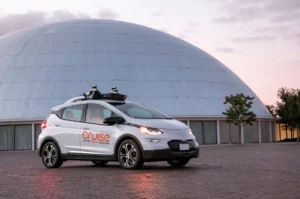
And while they look very much like the current shipping Bolt EV, under the hood, Vogt said that 40 percent of the parts are new, and most of those are focused on redundancy of parts and systems. Fifty vehicles have been built by GM, and production is expected to ramp up from here. Vogt says there isn’t yet a timeline for deploying the software that enables full self-driving, but he added that these are destined for deployment in fleets, rather than as individually owned consumer vehicles. As for deployment of these new cars that have actually been produced, Vogt says that they’ll start to be integrated into the “Cruise Anywhere” on-demand ride-hailing service offered to Cruise employees in San Francisco in the coming weeks. Vogt pointed out that this is the third generation of Cruise’s autonomous vehicle in just 14 months, which is indeed a remarkable timeline for development of a fully functional self-driving platform, even for testing purposes. He also took the opportunity to highlight the difference between what GM and Cruise have announced, and the kind of one-off demonstration vehicles other automakers and tech companies have brought to events like CES.